SDAA261 March 2026 TCA9846
2 Application
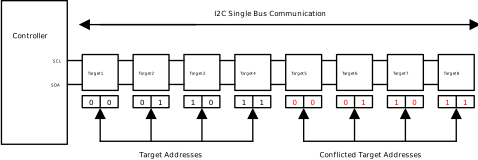 Figure 2-1 I2C Address Conflicts
A common design to counter these issues is to implement an I2C multiplexer or switch such as the TCA9848. This allows the splitting of the I2C communication bus to different lanes depending on the configuration. Instead of having a single bus with many targets, there can be multiple I2C communication lanes with few targets in each one. It benefits the system by reducing the parasitic capacitance per lane. The mux also has its own I2C addresses correlated to its channels. It allows for more targets to be communicated to without the concern of having address conflicts.
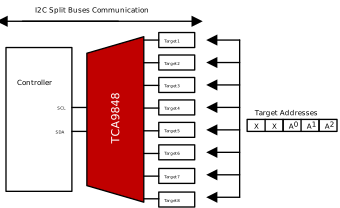 Figure 2-2 I2C Switch Solution
Switches such as the TCA9846 and TCA9848 can communicate directly to all targets at the same time, while the TCA9847 and TCA9849 muxes can communicate to only one target at a time. The caveat with the switches is that the same I2C signal is sent to all targets.
I2C standard communication is usually at 400kHz clock frequency. Advancements in the protocol introduced a newer mode called Fast Mode Plus. The communication was ramped up to 1MHz clock frequency, allowing the transfer of information to up to 1Mbps. To support these modes and faster speeds, the TCA984X family was developed. It is backward compatible and supports Fast or Standard mode for bidirectional communication in a mixed-speed I2C bus system.
An additional aspect of I2C is where a controller and the targets use different supply voltages. The TCA9848 or any other I2C switch or mux from the TCA984x family, allows the system to select each channel and translate up or down the bus signals to match the voltage level the controller and targets are passing and operating at. These devices can translate from 0.65V up to 3.3V.
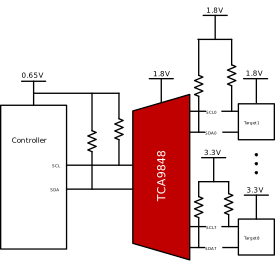 Figure 2-3 I2C Switch Voltage
Translation
Figure 2-3 I2C Switch Voltage
Translation